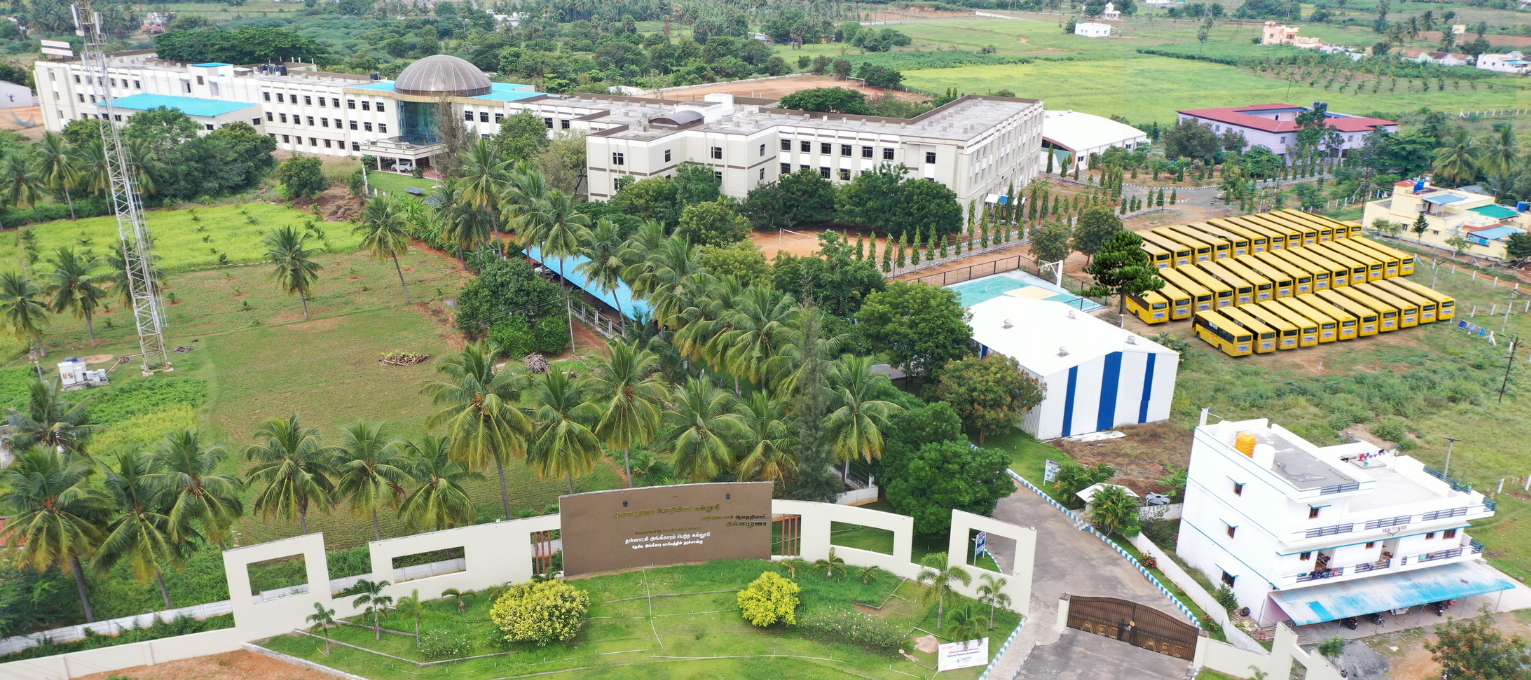
The Department of Electronics and Communication Engineering, established in 2010, is committed to delivering quality education in Electronics and Communication Engineering with a strong emphasis on academic excellence, innovation, research, and industry relevance. The department provides a learner-centric environment supported by well-equipped laboratories, experienced faculty members, and modern teaching methodologies that promote technical competence and professional development. Accredited by NBA since 2025, the department continuously strives to enhance the quality of education through outcome-based learning, industry collaboration, research activities, and skill development initiatives. Students are equipped with strong theoretical knowledge and practical exposure to meet the evolving demands of industry, higher education, and research. Further strengthening its academic portfolio, the department is introducing the M.E. Communication Systems postgraduate programme from the Academic Year 2026–2027. The programme is designed to provide advanced knowledge in modern communication technologies, foster research and innovation, and prepare graduates for leadership roles in industry, academia, and research organizations.

Emerge as Centre of excellence for quality technical education and research in electronics and communication engineering.

Engineering Graduates will be able to:
Apply the knowledge of mathematics, natural science, computing, and engineering fundamentals and an engineering specialisation to the solution of complex engineering problems.
Identify, formulate, and analyse complex engineering problems, reaching substantiated conclusions with consideration for the holistic nature of the problem.
Design creative solutions for complex engineering problems and design systems, components, or processes to meet identified needs — with consideration for public health and safety, and cultural, societal, and environmental factors. Sustainability is now intrinsic to design.
Conduct investigations of complex engineering problems using research-based knowledge and research methods, including design of experiments, analysis and interpretation of data, and synthesis of information to provide valid conclusions.
Create, select, and apply appropriate techniques, resources, and modern engineering and IT tools, including prediction and modelling — recognising their limitations — to solve complex engineering problems.
Analyse and evaluate societal and environmental aspects while solving complex engineering problems, considering their impact on sustainability with reference to economy, health, safety, legal frameworks, culture, and the environment.
Apply ethical principles and commit to professional ethics, human values, diversity, and inclusion; and adhere to relevant national and international laws.
Function effectively as an individual, and as a member or leader in diverse and multi-disciplinary teams.
Communicate effectively and inclusively within the engineering community and with society at large — comprehending and writing effective reports and design documentation, and making effective presentations — considering cultural, language, and learning differences.
Apply knowledge and understanding of engineering management principles and economic decision-making, and apply these to one's own work, as a member and leader in a team, to manage projects in multi-disciplinary environments.
Recognise the need for, and have the preparation and ability for, independent and life-long learning, adaptability to new and emerging technologies, and critical thinking in the broadest context of technological change.
Bachelor of Electronics and Communication Engineering Graduates shall
Students of Electronics and Communication Engineering shall have
State-of-the-art laboratories equipped with modern instruments for hands-on learning.
The Analog and Digital Circuits Laboratory is established to provide strong practical knowledge in the fundamentals of electronic circuit design and analysis. Students perform experiments on diode and transistor characteristics, rectifiers, amplifiers, oscillators, multivibrators, and basic analog applications. The digital section covers combinational and sequential logic circuits, counters, registers, and multiplexers. Emphasis is placed on circuit construction, measurement, troubleshooting, and result verification. The laboratory enhances students' understanding of theoretical concepts through real-time implementation.
Main Equipment: Analog and Digital Trainer Kits, Cathode Ray Oscilloscopes, Function Generators, Regulated DC Power Supplies, Digital Multimeters, Breadboards.
The Linear Integrated Circuits Laboratory focuses on the study and application of commonly used linear ICs in electronic systems. Students gain hands-on experience with operational amplifiers, timers, voltage regulators, waveform generators, comparators, and active filters. Experiments include amplifier configurations, signal conditioning circuits, oscillators, and voltage regulation techniques. The laboratory helps students understand practical limitations, performance parameters, and real-world applications of linear ICs.
Main Equipment: Op-Amp and Linear IC Trainer Kits, CRO, Signal Generators, Regulated Power Supplies, Digital Multimeters.
Software: Multisim.
The Digital Signal Processing Laboratory is designed to provide practical exposure to digital signal analysis and processing techniques used in modern communication and multimedia systems. Students conduct experiments on signal generation, convolution, correlation, FFT, IIR and FIR filter design, and spectral analysis. Both simulation-based and real-time DSP implementation approaches are emphasized to bridge theory and practice.
Main Equipment: DSP Processor Kits, Interface Modules, High-Performance Computer Systems.
Software: MATLAB.
The VLSI Design Laboratory offers practical training in the design and verification of digital integrated circuits using industry-standard tools. Students work on hardware description languages, logic synthesis, simulation, timing analysis, and FPGA implementation. The laboratory prepares students for semiconductor and chip design industries by introducing modern VLSI design methodologies.
Main Equipment: FPGA Development Boards.
Software: Xilinx, Tanner EDA.
The Communication Systems Laboratory provides hands-on experience in analog and digital communication techniques. Students perform experiments on amplitude, frequency, and phase modulation, digital modulation schemes, noise analysis, and multiplexing techniques. The laboratory helps students understand the behavior of communication systems under real-world conditions.
Main Equipment: Communication Trainer Kits, Cathode Ray Oscilloscopes, Spectrum Analyzer, Signal Generators, Power Supplies.
Software: MATLAB.
The Microprocessors and Microcontrollers Laboratory is intended to develop programming and interfacing skills using popular processors and controllers. Students learn assembly language and embedded C programming, along with interfacing peripherals such as LEDs, LCDs, keyboards, sensors, and motors. The laboratory supports embedded system design and real-time applications.
Main Equipment: 8086, 8051, ARM, PIC Trainer Kits, Interface Modules, PCs.
Software: Keil µVision, Proteus, MASM, Arduino IDE.
The Advanced Communication Laboratory provides exposure to modern and emerging communication technologies. Students perform experiments related to microwave engineering, antenna measurements, optical fiber communication, and wireless systems. The laboratory enhances analytical, experimental, and design skills required for advanced communication engineering applications.
Main Equipment: Microwave Test Benches, Optical Fiber Trainer Kits, Antenna Trainer Systems, Spectrum Analyzer, Network Analyzer.
Software: MATLAB, NS2.
| S.No | AU - FIN | AICTE ID | Name & Designation | Photo |
|---|---|---|---|---|
| 1 | 2649141981 | 1-10537020060 |
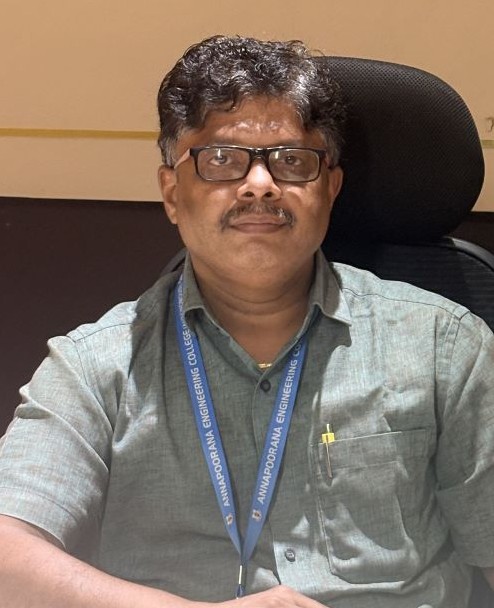
Dr. R. Vinothkanna
Professor
|
|
| 2 | 2639281972 | 1-2667671590 |
Mrs. Maria Dhayana Latha
Assistant Professor
|
|
Glimpses of department activities, events, and campus life.
Reach out to the Head of the Department.
M.E., Ph.D.